How much to charge for piano lessons in 2026
Third-party marketplace data puts most private piano lessons in the US between $40 and $80 an hour. But how much to charge for piano lessons is not an average question. It is an arithmetic one. Your rate is the income you need divided by the lesson hours you can realistically bill.
The short version
- Published "averages" are buyer-facing and often stale. The top-ranking cost pages quote ranges with no stated sample, and one still carries a 2020 byline.
- Marketplace listing averages skew low. Superprof's US piano average sits at $40/hour, because teachers set list prices to win beginners.
- Government wage data is not your rate. The federal wage survey for the occupation that covers private instructors excludes the self-employed entirely.
- Price from your own numbers instead: target income → gross up for tax, costs and leakage → divide by billable hours.
- In the worked example below, that produces $74 an hour, not the $40 to $80 an aggregator would have suggested.
What the rate data actually says (and why the average is nearly useless)
There is no credible, current, national average piano lesson rate for the US. That sounds like a dodge. It is the single most useful thing on this page, because it stops you from anchoring your business to a number nobody can trace.
Here is every source worth citing, with what it actually measures.
| Source | Figure | When and how it was collected | Why it is not your rate |
|---|---|---|---|
| BLS OEWS, self-enrichment teachers (25-3021) | Median $22.50/hr, mean $26.32/hr, 332,110 employed | May 2025 reference period, released May 15, 2026; mail survey of establishments | Explicitly excludes the self-employed. This is what schools pay staff instructors |
| ISM annual fees survey (UK) | Median private teaching rate £40/hr; regional medians from £34 to £55.75 | Fielded Feb 12 – May 4, 2026 by Naylor Research Partnership; 1,084 respondents | UK market and currency. Useful for shape, not level |
| Superprof US piano listings | $40/hr average; 97% of listed tutors offer a free first lesson | Live listing page headline, checked 2026-09-10 | Self-reported list prices, not transactions. Skews low |
| Lessons.com | $40–$80/hr private in-person; $30–$80 per session | "Estimates students get from teachers"; the page carries a 2026 headline and no visible sample | Aggregated quotes, undated, buyer-facing |
| Thumbtack | "Typically $50 to $60" per lesson | "Estimates they get from local professionals"; bylined August 26, 2020 | Aggregated quotes, six years old, buyer-facing |
Three things follow from that table.
Self-reported marketplace rates skew low, and you should assume it. A listing price is an ask, set by someone competing for a first-time beginner in a search result. It is not the price a teacher with a waitlist charges the family who has been with her for six years. When 97% of listings advertise a free first lesson, the list price is a marketing number.
Wage data measures a different job. The federal survey that covers private music instruction reports a $22.50 median hourly wage, and it does not cover self-employed people at all. That figure describes an instructor on a music school's payroll, whose employer handles the room, the scheduling, the billing and the empty slots. You do all of that yourself. The gap between $22.50 and your lesson rate is not profiteering. It is overhead and risk.
Averages hide the spread that matters. The ISM survey is the best-documented rate survey published in 2026, and its own regional table shows median private rates ranging from £34 to £55.75. That is a 64% spread inside one country, and the ISM notes the gap between its top and bottom regions is widening. A national average would have told a teacher in either region something misleading.
So stop shopping for a number. Build one.
The six factors that move a piano lesson rate
Before the formula, know which levers are real. These six explain almost all of the variation you will see in your own market.
| Factor | Which way it moves your rate | What to do about it |
|---|---|---|
| Metro cost of living | Largest single factor. The ISM data shows a 64% regional spread | Survey 5–8 studios within 20 minutes of you, not the national web |
| Credentials and results | Moves it up, but slowly, and only if parents can see the result | Lead with student outcomes, not degrees, when you announce a rate |
| Delivery: in-home, studio, online | In-home commands more, then costs it back in unpaid drive time | Price in-home separately, or add a travel fee. See the mileage math below |
| Lesson length | Longer lessons are more profitable per hour of your time | Do not price 30 minutes at exactly half of 60. See the table below |
| Student age and level | Advanced and adult students tolerate higher rates and cancel less | Consider a second, higher tier for advanced repertoire |
| Demand and waitlist | The only factor that gives you permission to move fast | A waitlist of three or more means your rate is below market |
The last one is worth sitting with. A waitlist is not a compliment. It is a pricing signal you are ignoring. If families are waiting, your rate is too low for the demand you have created, and the correction is a rate increase rather than a longer teaching day. That conversation has its own playbook in how to raise your lesson rates without losing students.
How to survey your local market in 30 minutes
Your market is not the internet. It is the set of teachers a family in your neighborhood would realistically consider, which in practice means a 20-minute drive. Here is how to find their rates without asking anyone an awkward question.
Search the way a parent would. Use "piano lessons" plus your town or your nearest recognizable neighborhood. Do it in a private browser window so your own history does not shape the results. Write down the first eight studios that are actual local teachers rather than national marketplaces.
Take rates from the studio's own site first. Many teachers publish tuition on a rates or policies page. That published number is the most reliable data point you will get, because it is what a parent is quoted.
Where nothing is published, use the local music school. Chain and community music schools almost always post tuition. Their rate includes a building, a receptionist and a teacher's split, so treat it as an upper bound on what families in your area will pay, not as a peer rate.
Record four columns: studio name, lesson length, published rate, and whether they are currently accepting students. That last column is the one nobody collects, and it is the most informative. A studio with a closed waitlist at $80 tells you far more than three studios with open slots at $50.
Then convert everything to an hourly equivalent so you are comparing the same unit. A $45 half-hour lesson is $90 an hour, and it will not look like it on your list until you do the division.
Eight data points from a 20-minute radius beat any national average ever published. Redo this once a year, in August.
The rate formula: how much to charge for piano lessons, from your own numbers
This is the calculator. It runs in six steps, on paper, in about ten minutes. Work top to bottom.
Step 1. Set your target take-home. The money you want to keep from teaching, after business expenses and self-employment tax, before federal and state income tax.
Step 2. Gross up for self-employment tax. Self-employment tax is 15.3%, applied to 92.35% of net profit, which is an effective 14.13%. Divide your Step 1 number by 0.8587.
Step 3. Add your annual business expenses. Software, tuning, method books, insurance, association dues, professional development, studio supplies. Add the total.
Step 4. Gross up for leakage. Card processing runs about 2.9% plus 30 cents per charge, and some lessons get canceled late and never recovered. Divide by 0.94 to cover roughly 6% of both.
Step 5. Count your real billable hours. Teaching weeks per year, multiplied by hours of lesson time per week. Be honest. Holidays, your own illness, and recital weeks are not billable.
Step 6. Divide. Step 4 result ÷ Step 5 result = your hourly rate. Round up to the nearest dollar or five.
The worked example
Maria teaches from home, wants $50,000 in her pocket, and has a full studio of roughly 30 students. The figures below are illustrative, not a benchmark.
| Step | Calculation | Result |
|---|---|---|
| 1. Target take-home | Chosen | $50,000 |
| 2. Self-employment tax | $50,000 ÷ 0.8587 | $58,227 |
| 3. Business expenses | + $216 software, $400 tuning, $600 music, $350 dues and insurance, $1,334 other | $61,127 |
| 4. Leakage gross-up | $61,127 ÷ 0.94 | $65,029 |
| 5. Billable hours | 40 teaching weeks × 22 lesson hours | 880 hours |
| 6. Hourly rate | $65,029 ÷ 880 | $74/hour |
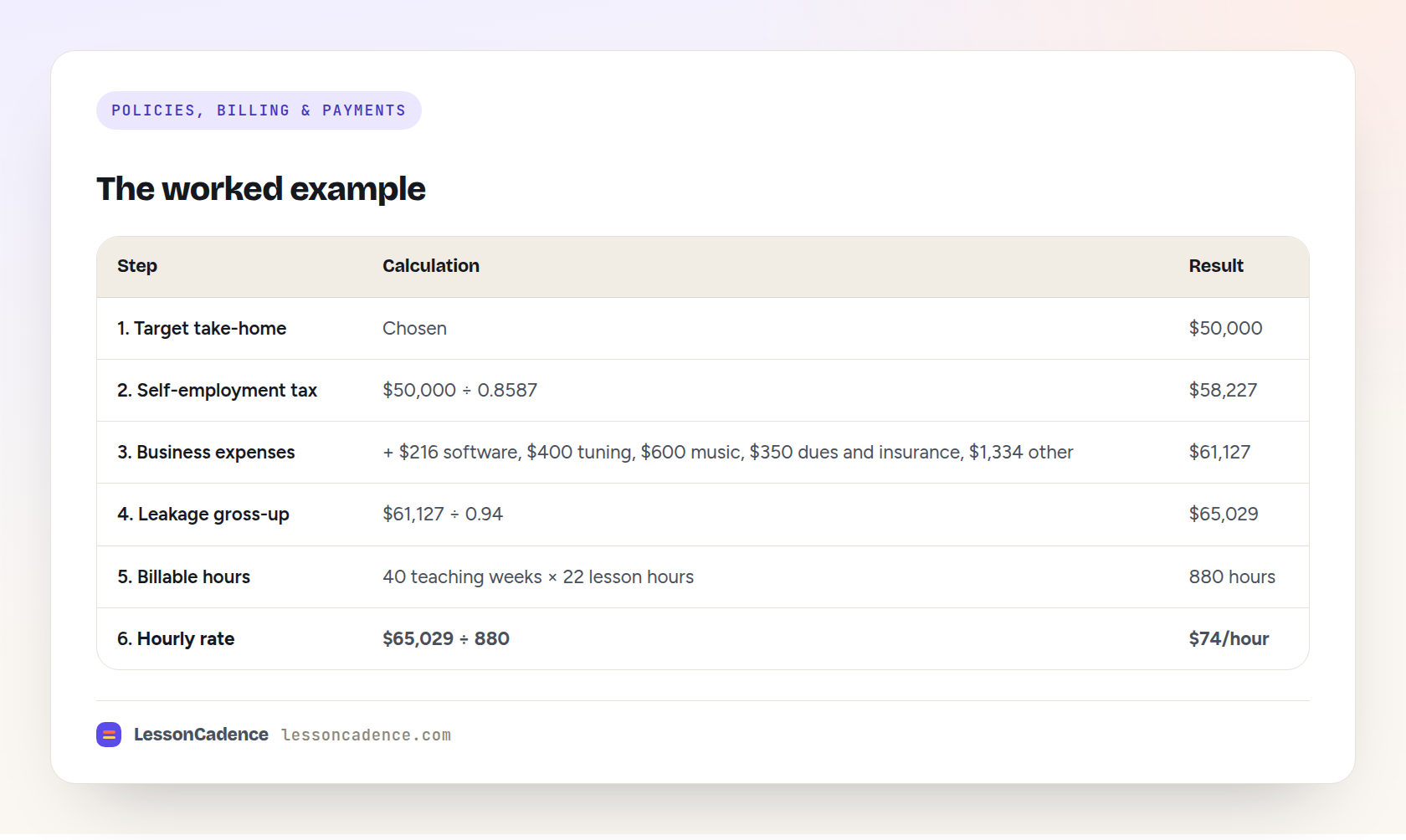
Notice what just happened. The aggregator range said $40 to $80. Maria's own numbers said $74, near the top of it. If she had split the difference and charged $60, she would have needed to teach 1,084 hours to hit the same take-home. That is 27 hours of lessons a week, every week, for 40 weeks.
Step 5 is where most teachers get it wrong, so run it at three levels:
| Billable hours per week | Annual billable hours | Rate needed for the same $65,029 |
|---|---|---|
| 22 hours | 880 | $74/hour |
| 19 hours | 760 | $86/hour |
| 16 hours | 640 | $102/hour |
A part-time studio is not a cheaper studio. It is a more expensive one per hour, because the same fixed costs and the same income target are spread across fewer hours.
The costs teachers forget to price in
Every number in Step 3 and Step 4 is a cost that quietly comes out of your rate. Here is what teachers most often leave out.
Self-employment tax. At 15.3% on 92.35% of profit, Maria's tax line in the example above is $8,227. That is not a rounding error. It is the equivalent of 111 lessons at $74.
Unrecovered late cancellations. One unenforced late cancel a week, at a 45-minute rate of $58, is $2,320 across a 40-week year. That is a full month of income. You can track cancellations in a spreadsheet and invoice the difference by hand. LessonCadence checks your cancellation window at the moment a family reschedules and either charges the lesson or banks a make-up credit, so the policy is enforced without a text message you did not want to send.
Unpaid drive time. If you teach eight in-home lessons a week at 10 miles round trip, that is 3,200 miles a year. At the IRS business rate of 76 cents per mile for the second half of 2026, up from 72.5 cents in the first half, that is $2,432 in vehicle cost, before you count the driving hours you cannot teach in.
Prep, notes and admin. Assume 10 minutes per lesson. Across 880 lesson hours, that is real time that has to be inside your rate, not outside it.
Instrument and space. Two tunings a year, a humidity system, regulation every few years, and the room itself. Tuning alone is a recurring cost most teachers never put on a spreadsheet.
Every one of these is also potentially deductible, which changes the tax math in your favor. That is a separate conversation, and the music teacher tax deduction checklist covers it properly.
Lesson length: why 30, 45 and 60 do not scale linearly
Most studios price 30 minutes at half the hourly rate. That is the most common pricing mistake in private teaching, and the reason is fixed per-lesson overhead.
Every lesson carries roughly the same 10 minutes of setup, notes, parent conversation and invoicing, whether it runs 30 minutes or 60. So a 30-minute lesson occupies 40 minutes of your life, and a 60-minute lesson occupies 70.
| Lesson length | Your actual time | Priced at simple fractions | Priced for equal effective rate |
|---|---|---|---|
| 30 minutes | 40 minutes | $37 | $42 |
| 45 minutes | 55 minutes | $55.50 | $58 |
| 60 minutes | 70 minutes | $74 | $74 |
The right-hand column earns you the same $63.43 per hour of actual working time at every length. The middle column pays you $55.50 an hour for a half-hour student and $63.43 for an hour student, which means your beginners are quietly subsidized by your advanced players.
Set the 60-minute rate from the formula. Then price 30 minutes at roughly 57% of it and 45 minutes at roughly 78%. The same logic drives group lesson pricing, where fixed overhead is shared across several families.
Monthly tuition versus per-lesson pricing
Once you have a rate, decide how it arrives. Per-lesson billing is simpler to explain and much worse to live on, because your income swings with the calendar. September has four Tuesdays. October has five.
Monthly tuition fixes that. Take the annual total and divide it into equal payments.
A 45-minute student at $58, across 40 teaching weeks, is $2,320 a year. Divided over 12 months, that is $193 a month. Over 10 months, September through June, it is $232 a month.
The annual total is identical. What changes is that you can budget, and the family stops recalculating the bill every month. Say it plainly in your policy: tuition is an annual fee paid in monthly installments, not a per-lesson charge. That single sentence prevents most billing arguments before they start.
When to charge more than everyone around you
Local surveying tells you what your market pays. It does not tell you what you are worth, and it has a well-known failure mode: everyone in a small market anchors to everyone else, and the whole region stays underpriced for a decade.
Charge above your local band when at least two of these are true:
- You have a waitlist of three or more students.
- Your retention is strong and families stay multiple years.
- You deliver something specific and visible: competition results, exam preparation, adult beginners who actually keep playing.
- You are the only teacher within reasonable distance who does the thing a family wants.
- Your own formula says the local rate cannot pay you a living.
That last one is decisive. If the local going rate will not fund your target income across the hours you can actually teach, matching it is not a market strategy. It is a slow decision to earn less than you need.
When your number lands above your market
This happens constantly, and it is not a sign the formula is broken. It means one of three things needs to change. Work through them in this order.
Close the gap over two years, not one. If your formula says $74 and your market sits at $58, a jump to $74 in September will cost you students. Two increases of roughly 13%, twelve months apart, gets you there with far less attrition, and each one is easier to justify than a single large move.
Or change the mix instead of the rate. Fewer 30-minute beginners and more 60-minute intermediate students raises your revenue per teaching hour without touching your published price. So does adding one group class in a slot you currently teach one student in.
Or cut the income target, deliberately. Sometimes the honest answer is that a full solo studio in your market supports $42,000 and not $50,000. Knowing that is not defeat. It tells you whether you need a second income stream, a different market, or a studio with a second teacher, and it tells you now rather than in March when the numbers do not work.
What you should not do is quietly absorb the gap and hope volume fixes it. Volume is the one lever that costs you evenings.
Independent tutors face the identical math, laid out in what independent tutors charge by subject.
FAQ
What is the average cost of piano lessons in 2026?
There is no citable national average. Aggregated quote data puts most US private lessons at $40 to $80 an hour, with no stated sample behind the range. Marketplace listing averages run lower, around $40 an hour, because they reflect asking prices rather than what established teachers actually collect.
How much should a beginner piano teacher charge?
Run the same formula, then start near the bottom of your local band rather than the bottom of a national range. Your costs do not shrink because you are new. If the formula says $74 and local studios charge $55 to $75, opening at $55 is reasonable. Opening at $35 is not.
Is it normal to charge for a late-canceled piano lesson?
Yes. A published notice window, commonly 24 hours, with the lesson charged or converted to a make-up credit, is standard practice in private studios. One unenforced late cancel a week costs $2,320 over a 40-week year at a $58 lesson rate, which is why the policy needs to be written down.
Should I charge monthly or per lesson for piano lessons?
Monthly, in almost every case. Divide the annual tuition into equal installments so your income does not swing between four-lesson and five-lesson months. Describe it as an annual fee paid monthly, not a per-lesson charge, and the recalculation arguments largely disappear.
Do online piano lessons cost less than in-person?
Usually somewhat less. Aggregated quote data puts online lessons at $35 to $70 an hour against $40 to $80 in person. Your costs also drop, because there is no travel and no studio space, so the profit difference is smaller than the price difference suggests.
Sources
- Bureau of Labor Statistics, Occupational Employment and Wage Statistics, Table 1, national data by occupation, May 2025 reference period (released May 15, 2026). Self-enrichment teachers (25-3021): 332,110 employed, $22.50 median hourly, $26.32 mean hourly, $54,740 mean annual. https://www.bls.gov/news.release/ocwage.t01.htm — checked 2026-09-10
- Bureau of Labor Statistics, OEWS Frequently Asked Questions: "The survey does not cover the self-employed, owners and partners in unincorporated firms, household workers, or unpaid family workers." https://www.bls.gov/oes/oes_ques.htm — checked 2026-09-10
- Bureau of Labor Statistics, Occupational Employment and Wages Summary, news release dated May 15, 2026, covering the May 2025 reference period. https://www.bls.gov/news.release/ocwage.nr0.htm — checked 2026-09-10
- Incorporated Society of Musicians (ISM), Music Teachers' Fees Survey 2026, fielded February 12 to May 4, 2026 by Naylor Research Partnership, 1,084 qualifying respondents. Median private teaching rate £40/hour; regional medians £34–£55.75 (report table). UK data, GBP. Summary: https://www.ismtrust.org/news/music-teachers-fees-survey-results-2026/ — full report: https://www.ismtrust.org/wp-content/uploads/2026/06/ISM_Fees-survey-2026_A5_Online-version.pdf — checked 2026-09-10
- Superprof, piano lessons in the United States listing page: "private piano lessons averaging at $40/hr"; 97% of tutors offer the first lesson free. Third-party marketplace, self-reported list prices; the page refuses automated readers, so the figures are from its indexed headline and summary. https://www.superprof.com/lessons/piano/united-states/ — checked 2026-09-10
- Lessons.com, "How Much Do Piano Lessons Cost? (2026)": $40–$80/hour private in-person, $35–$70/hour online, $30–$80 per session. Methodology stated as tracking student-received estimates. Third-party aggregator; the page refuses automated readers, so figures are from its indexed summary. https://lessons.com/costs/piano-lessons-cost — checked 2026-09-10
- Thumbtack, piano lessons cost page: "A piano lesson will typically cost between $50 and $60." Methodology stated as tracking estimates from local professionals; bylined August 26, 2020. Third-party aggregator. https://www.thumbtack.com/p/piano-lessons-cost — checked 2026-09-10
- Internal Revenue Service, Topic no. 554, Self-employment tax: rate of 15.3% (12.4% Social Security plus 2.9% Medicare); "the amount subject to self-employment tax is 92.35% of your net earnings from self-employment." https://www.irs.gov/taxtopics/tc554 — checked 2026-09-10
- Internal Revenue Service, Standard mileage rates: business rate of 72.5 cents per mile January 1 – June 30, 2026, and 76 cents per mile July 1 – December 31, 2026. https://www.irs.gov/tax-professionals/standard-mileage-rates — checked 2026-09-10
- Stripe, pricing: 2.9% + 30¢ per successful domestic card transaction; ACH Direct Debit 0.8% capped at $5.00. https://stripe.com/pricing — checked 2026-09-10
Written for teachers by the LessonCadence team. Last reviewed: 2026-09-10.